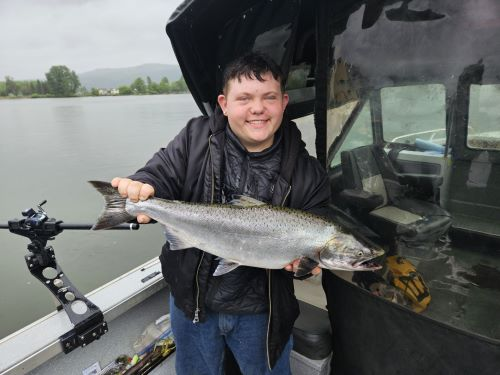

My first fishing memory was on my grandpa’s boat on the Rogue River. He was the best fishing guide for Spring Chinook that a kid could ask for. On that hand-built plywood boat I learned the basics of what I still use today. That river was my classroom. He was the teacher. The subjects were knots, reading water, setting lines, rigging baits and spinners, and dropping the anchor. From that experience, I developed a love for Spring Chinook fishing. They are unrivaled on the plate and each one reminds me of that day I reeled in my first fish.
Table of contents
Columbia River Spring Chinook Fishing

Spring Chinook are generally limited to rivers that flow deep inland. This makes Spring Chinook fishing a rare treat for a lot of people. Most Spring Chinook fishing in these areas is by boat. A few places do offer opportunities to fish from the bank. The principles are the same for bank fishing with a few tackle modifications for casting. Some bank fishermen have started using kayaks to set their lines, making many of the techniques nearly identical. With that said, there is no “right way”.
My first rule in any type of fishing, but Spring Chinook in particular. is “don’t argue with the fish”. This means understanding what they want and how they behave.
Spring Chinook Behavior and Biology
Spring Chinook are marathon runners. An upriver Spring Chinook entering the Columbia in March may be getting ready to travel over a thousand miles upriver. They won’t spawn until the fall and may spend 9 months without eating. This is why they are such high quality on the table when you catch them down low. Keeping a few principles in mind can make all the difference when targeting them.
Saving energy is their top priority
The cold water and long journey means that their top priority is to conserve energy. The deeper channels in the middle of the river often have swifter currents and colder water. They will often avoid these areas and seek the edges with less current and slightly warmer water. In smaller or shallower rivers they will follow the seams and edges created by shelves and “breaks” along the bottom. In bigger rivers like the Columbia this means that the fish concentrate around points and turns. Knowing how to predict the location of these lanes can make a wide stretch of river a lot smaller.
Spring Chinook Like to Keep Moving
There is little to slow down spring Chinook, especially in bigger rivers like the Columbia. The things that slow salmon from moving upstream are warm water, excessive current, rough water, and predators. Spring tends to have cool water and moderate currents in most rivers. Once fish are in the river, unless there are predators blocking them, Spring Chinook will keep moving upriver. This is different than fall salmon that will hold up in the estuary and acclimate to warm water.
The feeding instinct lasts longer
Maybe it’s cold water, maybe it’s genetics, maybe it’s both. Spring Chinook seem to keep their feeding instinct more active for a longer period of time. As a general rule, the colder the water and the closer to the ocean, the stronger the feeding instinct. This is when Herring and Anchovies shine. As the water warms, the guarding instinct becomes predominant. More active presentations like plugs and spinners become effective.
Their eyes change
Unlike steelhead that can spot an angler from 20 yards away on the bank, salmon are nearsighted. This doesn’t mean they don’t have some visual tricks up their sleeves. While things may look a bit fuzzy to them from farther away, they are still highly sensitive to light. They also have a remarkable ability to change what parts of the spectrum they are sensitive to.
Normally their eyes are more sensitive to the shorter end of the spectrum, including UV light. This helps them out down deep where longer wavelengths struggle to reach. When they get into murkier water their eyes make a chemical change. This shifts their sensitivity towards the red end of the spectrum. This is because the longer wavelengths of red light penetrate murkier water better. This is also why NASA uses infrared telescopes to look into dusty areas of space. In the river they generally won’t be a hundred feet down, so they don’t need UV as much. This drives a lot of why certain colors work better at certain times of year.
Trolling for Salmon vs Anchor Fishing
This debate is often framed as “going to the fish” vs “waiting for the fish”. There’s some sense in both.
Fishing Spring Chinook while Anchored
Given the choice, I prefer to fish for Spring Chinook while anchored. If you select the right spot, you can almost guarantee that every fish will see your gear. It’s also much easier to keep everything fishing consistently and you stay in the lane. If it’s windy, you can often find a good fishing spot that is protected and keep fishing. I know that my friends and clients also appreciate being under cover with the heater going. Being successful depends heavily on your ability to select a good spot. You are also limited to spots that have enough current to work your gear. Fishing on anchor is also generally more effective when the water temperature reaches the mid 50’s.
Fishing setups for Spring Chinook while anchored

Plugs are the main choice for Spring Chinook Fishing. The most popular salmon plugs are the Kwickfish by Luhr Jensen and the Killer FIsh by Brad’s. The Mag Lip by Yakima Bait is another popular Spring Chinook plug. I personally prefer the Killer Fish by Brad’s. A size 14 is my go-to, although I have caught fish on size 15 if water conditions allow for it.
I typically “wrap” my plugs with tuna belly, although my neighbor swears by sardine. Some fishermen will add scents. Anise, garlic, tuna, herring and anchovy are all popular. I do not typically add anything but a little anise oil. The effectiveness of scents seems to vary depending on how much feeding instinct the fish still have. One thing I know for certain though is that “bad scents” can ruin your chances. Fuel, oil, sunscreen, hand lotions, old bait, and scented soap residue can cause a fish to abandon a bite. I always keep a cleaner on board and wash my hands and lures often. Gloves also help with scent control.
Deploying plugs
If I’m in water more than about 8 feet deep I use weight to get things to the bottom. I attach a 6 oz pyramid sinker to a 16 to 20″ dropper. The dropper goes at the end of the main line with a bead ahead of the swivel.
I cast the lead out to where you want to fish and let it sink to the bottom. I use a snap and swivel to clip the plug to the mainline and slide it down. The plug’s action will pull it down the line until the snap is stopped by the bead. If the plug stays on top of the water, you don’t have enough current to fish with plugs. In shallower water you can forego the weight, and drift it back the desired distance. The action will pull it to the bottom.
Old School Spring Chinook Setup
Another popular anchor fishing method is to rig up a whole anchovy so that it spins. Usually this is attached behind a spreader with a dropper leading down to a bank sinker. Drop the setup into the water. Walk it down to the desired spot by lifting the rod tip and letting line out while it drifts back. Alternatively you can put an unweighted spinner at the end of the line. While these are considered “old school” techniques in a lot of areas. They’re still favorites and catch a lot of fish, particularly in rivers with narrower lanes like the Rogue.
Picking the Right Spot for Spring Chinook
Figuring out where the fish want to be and where you want to fish is an art form with Springers. This is where having a fishing guide or buddy with lots of experience and local knowledge can help. There are a few basic rules to help beginners though.
- When the water gets murky, go shallow. The edges of the river slow the current, creating an easier path for the fish. The shallower water also means more light gets to the bottom. More light means the fish can see your gear to attack it.
- If you’re anchored and the boat is rocking the springers will not come knocking. If your gear isn’t working properly, nothing else will matter. Having the boat swing around in the wind is the number one reason this will happen. Finding a spot where you won’t get blown around is key.
- Salmon look for the easy path. They will seek out the edges of eddies, cut corners, and seek out slow water whenever possible. There are a lot of myths about whether they prefer the south side or the north side of the river. The reality is that they generally prefer the easy side.
Fishing for Spring Chinook while Trolling
Trolling can help you figure out where the fish are at. In a big river like the Columbia, this is useful, especially if you aren’t sure what depth they’re traveling at. While trolling does have the advantage of covering more water, it is harder to keep a consistent presentation. Lines will need to be adjusted to keep gear near the bottom. Wind can also throw a boat off course. Trolling with the wind can help keep things steady when possible. If you want to fish in areas with little or no downstream current, trolling is your only choice.
Trolling patterns for Spring Chinook
If I’m trying to zero in on the fish I will work a range of depths. If I’m running triangles, I will try to follow a series of depth contours, paralleling the shore. This way I can keep my gear close to the bottom. If I’m fishing 360 flashers then I’ll often use a zigzag pattern. This lets me cover more depth ranges. The action of the 360 gives me a little more forgiveness about being right on the bottom. Even then I limit myself to no more than 10 feet of depth change per pass.
Tackle setups for Spring Chinook Trolling

Rigging a cut-plug herring behind an inline flasher is usually the best bet in the early season. The fish hug the bottom so inline flashers have the advantage. I’m partial to the Leo, Shortbus, and Yakima Bait all make good options.
There are many opinions and secret recipes for brine and colors. If I’m brining my bait I use the natural color one from Northwest Bait and Scent. Their brine doesn’t shrivel the bait and holds it well for up to a week. This is handy if you don’t use all of your bait in a day.
Things change once the water begins to warm up into the 60’s. Plastic “stuffer baits” and spinners with hoochies behind them become more effective. Yakima Bait Spinfish and cut plugs are good choices. Brad’s Original Superbaits, and cut plugs, are also great options. These can be fished behind a triangle flasher but do best behind a 360 flasher. My favorite is the one made by X2 Fishing (disclosure; I have a sponsorship agreement with them). Protroll, Shortbus, and others also catch a lot of fish and i used them successfully for years.
Setting Expectations
Columbia River Spring Chinook fishing is one of the most challenging fisheries in our area. I use the best bait I can find. This means seeking out special deals with local bait shops and pre-sorting the packs of frozen herring. I purchase the tuna bellies for my bait wraps from a local shop during the fall tuna season. I’ve refined my lure selection. I’ve tuned my setup. I pick out the best spot possible.
With that said, a large school of herring just off the mouth can distract the fish from entering the river. The annual smelt run can suddenly show up, fill bellies, and cause the fish to be sluggish on the bite. A pod of Sea Lions can set up around the bend from you. Particularly in the early season it is not uncommon to see one fish for every three or four boats. So why do it?
Springer fishing is the opportunity to shake off the winter doldrums. There is nothing like sitting under the cover and watching the rain on the water while the heater is going. Being anchored gives the opportunity to share stories and conversation. All of this while the rods are working to bring one of the biggest harbingers of spring to the boat. When we do catch them, Columbia River Spring Chinook are table fare like no other.
Ultimately, the challenge of catching a Spring Chinook is it’s own reward. When the rod goes down, your heart jumps and the adrenaline starts pumping. Bringing a Spring Chinook over the gunnel is a rare accomplishment for most. Knowing that you’ve done it means you now have a story to tell for life.